"They look at the computer more than the patient"
Last month I had lunch with the director of a neighborhood ENT clinic in Seoul. There were two monitors on the desk in the exam room, and beside them a stack of paper charts. "I look at the computer more than the patient," he said with a smile. It sounded like a joke, but the truth in it came through.
In the previous installment on tax and accounting automation, we walked through where automation can fit step by step, from invoice handling to year-end closing. Clinics are essentially similar. There is more repetitive recording work that does not need to stay in human hands than you might think.
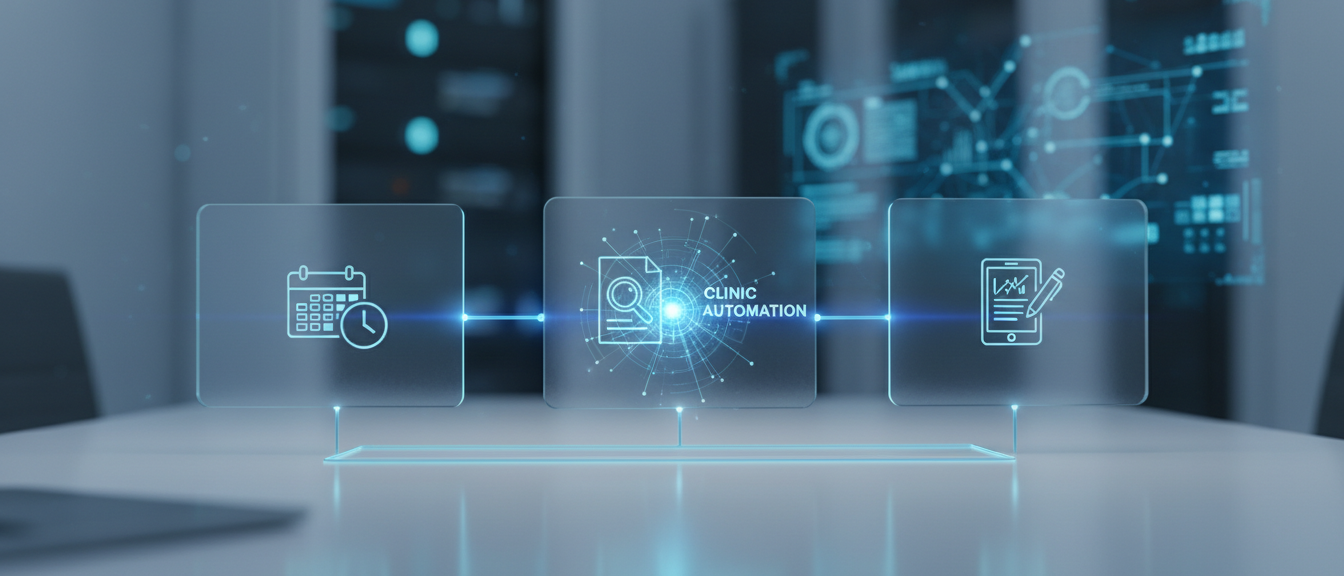
The three areas clinics should automate first
Reservations, intake, and charts. These three areas deliver the fastest returns when a clinic turns to automation. The most visible shift in 2026 is AI being layered on top of the EMR (Electronic Medical Record — the paper chart moved onto a PC screen).
How is the EMR market moving right now
UISARANG (now GC Medi-AI), the top EMR provider for clinics in Korea, unveiled "UISARANG AI" in March 2026. Commercial rollout is scheduled for July. Because it layers AI on top of an EMR already installed in roughly 16,000 hospitals and clinics nationwide, clinics get the benefits of automation without having to replace the system they already use.
According to UISARANG AI's launch material, automatic clinical-note drafting cuts consultation time by 60%, and automated claim-file generation with pre-emptive deduction-risk alerts shortens claim processing time by 80%. The 80% figure can sound abstract, but it means a clinic that used to process 60 claims a day now processes 12. That's an entire afternoon freed up for one staff member.
Other EMR companies — Bit Computer, Ezis Healthcare, EzCaretech — are moving in the same direction. The healthcare trade publication Medical Times described this trend as "an EMR war shifting from simple data-recording devices to intelligent medical platforms." The phrasing is grand, but what clinics actually feel is more modest. The work they do most often becomes automated. That is all.
Reservations, intake, charts — why the order matters
I don't recommend bringing automation into a clinic all at once. When patient flow, staff workflow, and above all the director's clinical habits collide with the system, things often slow down rather than speed up.
In my experience, the safest place to start is reservation automation. A chatbot takes the first pass at booking inquiries coming through KakaoTalk or Naver Talk Talk, and only the open time slots are surfaced back to the patient. A significant chunk of one staff member's morning workload disappears. The setup cost is also the lightest.
Next is electronic intake. Before the consultation, the patient enters symptoms, current medications, and history on mobile, and it appears immediately on the monitor in the exam room. The director doesn't have to start with "What's bothering you?" It is also an area that scores surprisingly well in patient-satisfaction surveys. The feeling of "having done something while waiting" matters more to patients than you might expect.
Last comes chart automation, where AI listens during the consultation and drafts the clinical note. This carries the highest implementation difficulty. Speech-recognition accuracy, medical terminology, privacy protection — there is a lot to take care of. That is why a solution built into the EMR, like UISARANG AI, becomes the most realistic option for clinics. Solving it inside the EMR in one place is far less of an operational burden than bolting on a separate solution.
Patient satisfaction and operational efficiency, both at once
"Won't automation make patients feel cold?" It is a concern I hear often. Honestly, I thought the same at first. But when you listen to clinics that have actually adopted it, the opposite tends to be true. The Ministry of Health and Welfare also officially cites improvements in patient safety and clinical precision as effects of adopting AI-based consultation systems.
The reason is simple. The more staff are freed from administrative work, the more time they spend making eye contact with patients. When the director isn't tethered to chart entry, they can look the patient in the face and talk. The time saved by automation flows directly into person-to-person care.
Closing the series — the road through six verticals
If you've followed this series from episode 1, you've walked through six industries with us: manufacturing → e-commerce → HR → logistics → tax & accounting → clinics. The industries were different, but the same question came up every time. "Does this task really have to be done by a person?" The places where the answer was "not necessarily" turned out to be where automation took root.
Each industry has a different order of adoption and different points where the effect shows up. Manufacturing starts with line data, e-commerce with CS, logistics with dispatch, and clinics with reservations. Go back to the episode closest to your industry, and you'll see where to take the next step.
At 5years+, we have been working step by step — from AI automation on top of the EMR to small PoCs — with SMEs and clinics in Korea and Japan. If you are at the "I don't know where to start" stage, a casual conversation is a fine place to begin. For any questions, feel free to reach out via the 5years+ free consultation.
Thank you for following the series to the end.