Monday morning, on a D2C office monitor
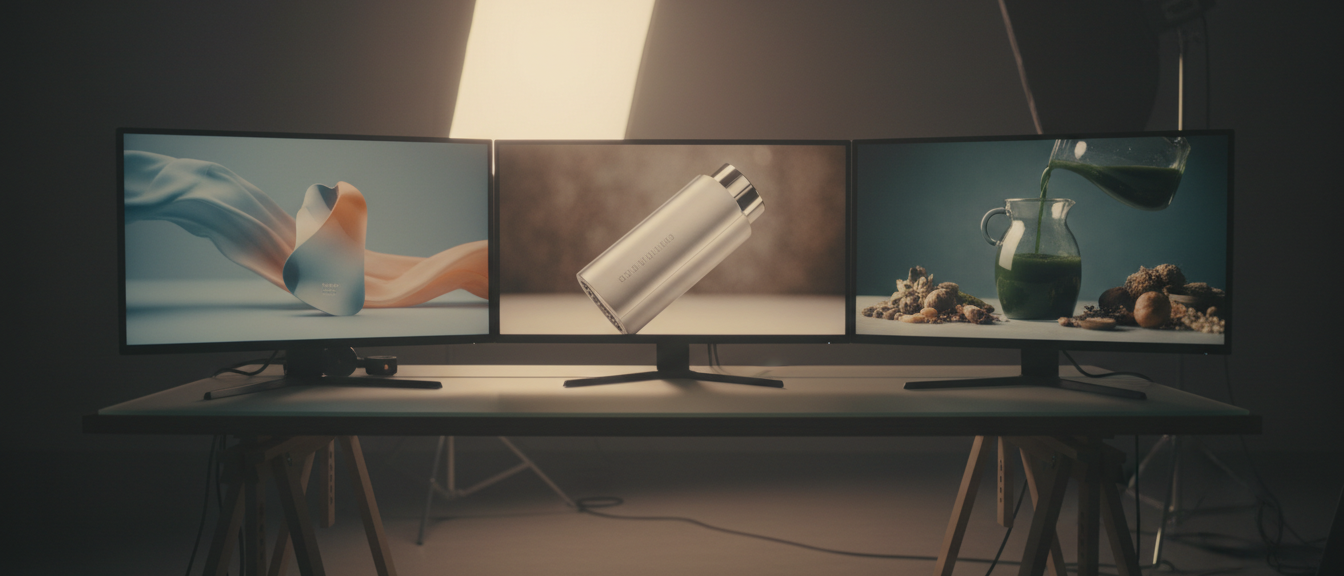
The founder of a D2C cosmetics brand I met last month pointed at his monitor and said, "Even with two designers running at full capacity, two videos a week was our ceiling. But starting this month, the same team is shipping five a week." On one corner of his desk, a 5-second Runway clip was looping; on another screen, Gemini Image was rendering candidates for a new key visual.
The production unit for ad creative is shifting. The proposition from the previous post — sales bot build notes — that "automation doesn't replace people; it relocates their time" — turned out to apply almost identically to ad production.
Price collapsed first
Pull together domestic press coverage from late 2025 and the numbers move pretty roughly. Production costs for 10-30 second short-form AI ads dropped to roughly KRW 150,000 to 2 million — half to one-hundredth of conventional live-action shoots, depending on the source. According to one ad-industry outlet, the number of AI video and image creators listed on Kmong tripled in a year, as of September 2025.
Enterprise cases are more dramatic. LGU+ reported about a 95% production-cost reduction with its in-house AI solution; Coca-Cola said one campaign's production cycle shrank from a year to a month. That "95% reduction" figure is an outlier, though. On the ground, the realistic savings range I see at SMBs and D2C brands sits closer to 30-60%. Still not a small number.
The workflow — from key visual to final cut
The structure itself is simple. It's not that more steps were added — two or three of the steps a human used to handle have been replaced by models.
① Gemini Image — key visuals and stills
Product shots, logo-free tone-and-manner key visuals, and poster-style stills are most stable with the Gemini Image family. It handles luxury-tone direction — slate backgrounds, marble surfaces, rim lighting — well. At first I assumed one video model could do everything end-to-end, but in practice, splitting the job — "stills go to the still-image model" — produced the most consistent quality lift. Close-ups involving fingers, logos, or small text get routed here almost without exception.
② Runway Gen-4 / 4.5 — five to seven 5-second clips
A single ad usually contains five to seven cuts. We pull 5 to 10 seconds per clip out of Runway. The key advantage is being able to direct camera framing and motion in text. Cut variations that used to take outsourced vendors days can be generated in five or six versions inside 30 minutes. One caveat: fingers, small logos, and complex text still break. For product close-ups, the safer route is still images from Gemini with cut inserts, rather than Runway video.
③ ComfyUI — interpolation, upscaling, tone matching
The 24fps 5-second clips Runway spits out feel slightly choppy if used as-is. ComfyUI's FILM VFI node interpolates them up to 60fps, which smooths the motion on social feeds. The 720p output gets pushed to 4K via upscaler nodes. When clip-to-clip tone is subtly off, ControlNet Depth and Canny lock in framing consistency. It's unglamorous work, but the perceptual gap between videos that skip this step and those that go through it is the largest anywhere in the pipeline.
④ Premiere / CapCut — editing, captions, delivery
The final stage is human. Ordering the 5-second clips, timing captions, color-grading to brand. This is where "the brand's breathing" — something no model can mimic — gets decided.
What "five a week" looks like on a calendar
Slice up a single week and it goes like this. Monday morning, Gemini Image locks in key visuals for that week's five spots. Tuesday through Thursday, Runway runs clip generation while ComfyUI post-processing is slotted in parallel. Friday morning, Premiere handles editing and captioning; delivery in the afternoon. One designer spends their time on key visual planning and tone management; the other owns model prompts and the post-processing pipeline. The opening line — "two people, five videos a week" — fits this timetable exactly.
So, are we cutting designers?
Every time I get this question, the answer comes out carefully. The short version: this doesn't replace payroll. It shifts a designer's time from "building each cut by hand" to "planning key visuals, managing brand tone, and engineering model prompts." When the same team moves from two videos a week to five, it doesn't mean headcount went down — it means the same headcount can now throw 2.5x more hypotheses at the market. For e-commerce and D2C, where creative needs to rotate weekly, that difference is far larger than simple cost reduction.
The practical hurdles are real. Model licensing costs, copyright review for external distribution, prompt guidelines that keep brand tone from drifting. Without operational rules nailed down in advance, you end up with "faster, sure, but the tone shifts week to week." The part of an ad video workflow setup that consumes the most time is exactly this operational-rules layer.
See three sample videos before you decide
5years+ has been running this workflow's setup and operations with e-commerce and D2C brands. We'll produce three sample videos for free, using your product shots, key visuals, and 5-second clips. See the output first, then decide whether this approach fits your product and brand tone. Just share a few product photos and a brand-tone reference at Free consultation.
Next time, the camera moves again. We follow the operational log of how 1,000 paper drawings stacked in the corner of a factory office flowed into digital data inside four weeks.